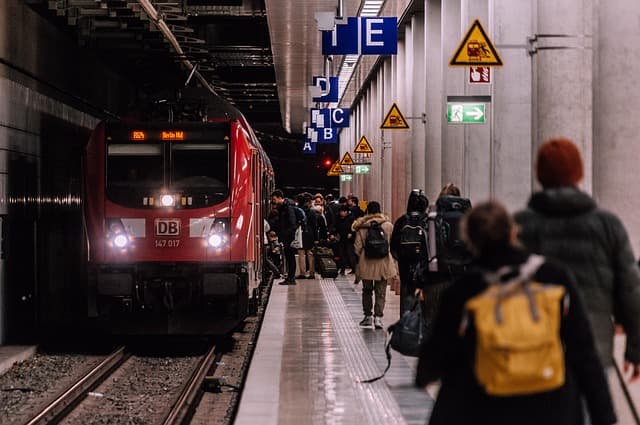
The deepest metro in the world in Pyongyang, the metro museum in Athens, and other metro systems you must descend into.
Why take the subway when you have your own car? And why take the subway on vacation? People prefer to spend hours stuck in traffic, and when in a foreign country, they are convinced that they will learn much more about it from the taxi window. Meanwhile, in many cities around the world, the subway is rapidly ceasing to be a faceless mode of transportation — world-renowned architects and artists are being brought in to design new stations, and in some places, the subway was created from the outset as a unique attraction designed to please the eye, inspire pride, and convey national character. After all, underground architectural monuments can be just as surprising as the most striking above-ground landmarks.
Pyongyang (DPRK)
The layout of the deepest (about 110 m) metro station resembles crossed Jedi swords: two lines, red and blue, intersect at one point—the passage from the Voennaya Pobeda station to the Boevoy Tovarishch platform. This is the only metro in the world where the names of the vast majority of stations have no connection with above-ground objects (for example, one of the terminal stations is called Rakwon — Paradise). However, tourists who decide to visit the Pyongyang metro will have to limit themselves to a short journey between the two terminal stations at the top of the red line. The rest of the metro is closed to foreigners. The two platforms that can be visited (Puhung and Yongwang) are designed on a Moscow scale and decorated in the style of socialist realism: mosaic panels tell the story of the lives of the Great Leaders and ordinary workers, while clusters of chandeliers add national color. The atmosphere matches the decor: loudspeakers broadcast patriotic songs and marches, and girls in military uniforms give the signals for trains to depart. Rumor has it that these stations, built later than the others, are a “Potemkin village” and are much more impressive than the rest. Finding out the truth is like looking at the dark side of the moon. There is a belief that the other stations are closed altogether due to a shortage of electricity in the country.
Hours of operation: 5:00 a.m. to 9:30 p.m.
Cost of travel: 5 won (about 1 ruble)
Important station: Puhung.
Bilbao (Spain)
Until the end of the last century, the largest city in the Basque Country was known only for its metallurgical industry. The metro, designed by the famous British architect Norman Foster, was only opened here in 1995, two years before the famous Guggenheim Museum, created by another master, Frank Gehry. The Bilbao metro is an example of modern architecture, where functionality, expressed in engineering communications and design, is an aesthetic in itself, without the need for decorative elements. It is noteworthy that the new metro has been recognized as the cleanest in Europe on more than one occasion. Two lines of unusual colors (orange and black) run parallel for half the way (you can get on trains of different lines from the same platform), and then diverge in different directions, like the horns of the letter Y. The platforms are located at a shallow depth, which allows the use of natural sunlight, which is abundant all year round. The architect even reimagined the familiar box-shaped platform: Abando station resembles a tube with rounded walls and a ceiling covered with sheets of silver metal. But most of all, the townspeople loved the glass entrances to the metro, sticking out of the ground like breathing tubes, affectionately calling them “fosteritos.” Incidentally, in 1998, Norman Foster received the Brunel Architecture Award for the project as a whole and the Sarriko station in particular.
Hours of operation: 6:00 a.m. to 11:00 p.m. (Fridays 6:00 a.m. to 2:00 a.m.)
Cost of travel: €1.40 (within zone 1)
Important station: Abando.
Naples (Italy)
The Naples metro underwent a cultural transformation recently, between 2001 and 2007, with the authorities hoping that this project would improve the city’s reputation, which was better known for the Camorra mafia and Vespa-riding thieves than for its rich artistic traditions. As a result of renovations involving leading contemporary Italian artists, architects, and art critics, the six central stations on the red line were unofficially nicknamed Metrò dell’Arte (Metro of Art). The Museo station, for example, is decorated with ancient Roman artifacts against a backdrop of bluish-milky Plexiglas panels, the Dante atrium features a neon installation quoting Dante Alighieri and conceptually screwed-to-the-wall shoes, while the central corridor of Materdei is decorated with sculptural “structures” by the father of minimalism, American artist Sol LeWitt. The pedestrian areas in front of the stations are stylistically linked to the entrances and underground space to form a single whole: the architect of the Salvator Rosa station, Alessandro Mendini, known for his bright, eccentric style, not only designed the station, but also invited artists to paint the walls of the buildings surrounding the square. The authorities in Naples do not intend to stop there: the opening of the Monte St Angelo station, designed by sculptor Anish Kapoor, is scheduled for 2010, with an entrance resembling a giant burrow.
Opening hours 06:00—23:00
Ticket price €1.10
Important station Salvator Rosa.
Lisbon (Portugal)
The metro stations in Portugal’s capital are designed without any particular architectural frills, but they are decorated in a highly decorative manner — with traditional glazed azulejo tiles. With minimal financial investment from the impoverished state, starting in 1950, artist Maria Keil personally decorated 19 stations (including Intendente, Anjos, Alvalade, Campo Pequeno, Restauradores), reviving a half-forgotten genre and inspiring a whole generation of artists. They began to assemble puzzles from tiles, creating large pictorial panels in a free sequence (Campo Grande, Oriente), or covering walls with trompe l’oeil tiles with various optical effects (Colegio Militar). The national tradition continues to this day: the spacious and bright Olaias station features huge ceramic panels, multicolored stained glass windows resembling broken tiles, and tall columns the color of unfired clay.
Hours of operation: 6:30 a.m. to 1:00 a.m.
Cost of travel €0.80
Important station Olaias.
Athens
The Athens Metro was commissioned in 1869, just six years after the oldest metro system in London. Its construction was akin to archaeological excavations, and as it turned out, not in vain: many of the artifacts unearthed at that time are now on display in museum showcases at the stations. At the Syntagma platform, in addition to capitals and amphorae behind glass, there is a real soil section on display, which even includes an ancient burial site. At the Akropoli station, there are copies of marble sculptures and architectural fragments from the British Museum’s collections, which Greece has been negotiating to return to the Parthenon since 1983. Antiquities often coexist with the works of contemporary artists: in the mirrored atrium of the same Syntagma station, umbrellas by the famous artist Georgios Zongolopoulos are suspended, at Larissa station, instead of the usual benches, people sit on the knees of metal men in bowler hats, and at Ethniki Amyna, Kostas Tsoklis has “planted” a forest of artificial trees under the roof itself, calling the installation “Underground Park.”
Hours of operation: 5:30 a.m. to midnight (Mon-Thu), 5:30 a.m. to 2 a.m. (Fri-Sat)
Trip cost €1 (a single ticket entitles you to travel on the metro, buses, trolleybuses, trams, and suburban trains for 90 minutes from the moment of activation)
Important station Syntagma.