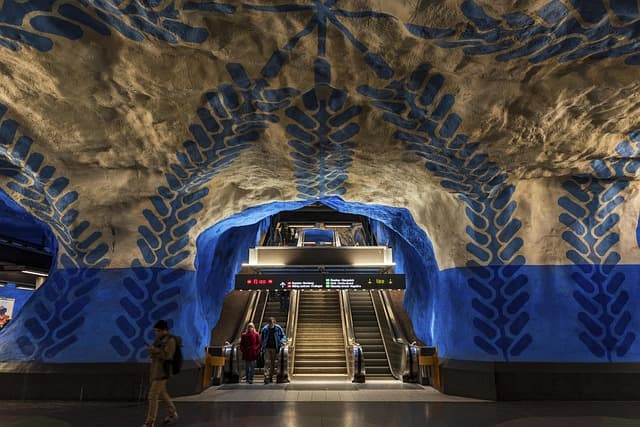
The Stockholm subway is truly unique: it has 100 stations, and each one has walls and waiting rooms that are true works of art. So, the Stockholm subway is essentially the world’s longest art gallery (110 km!).
Artists have played an important role in the creation of new stations since 1957. Over time, earlier stations, which initially had no artistic decoration, were decorated with sculptures, wall panels, and installations.
A day on the Stockholm metro can be compared to a visit to the world’s longest art gallery. We will tell you about just a few of the magnificent examples of the beauty that awaits you underground in the Swedish capital.
T-Centralen
The central station of the Stockholm metro, called T-Centralen, was opened in 1957 and became the first station where passengers could immerse themselves in the world of art. The platform of the blue line, which is also decorated in blue, is undoubtedly one of the most unique places in the entire public transport system of the Swedish capital. This platform was only opened in 1975, when the construction of the entire blue line to the Hjulsta district was completed.
An entirely blue subway platform may seem somewhat excessive. Art historian Marie Andersson believes that artist Per Olof Ultvedt chose blue tones not only for their aesthetic value, but also for their calming effect on the psyche.
“I think Per Olof Ultvedt wanted to create a calming atmosphere, because people are always in a hurry at this station. They are transferring from one line to another or changing to the city train station. That’s why I think he chose blue and simple stylized floral and ivy motifs so that passengers could relax and take a break,” says Marie.
Stadion
The stadium in the Östermalm district is the center of the annual Stockholm Pride festival. As a greeting to festival participants, the vaulted light blue walls of the nearest metro station are decorated with a bright multicolored rainbow, as if by accident.
As guide Marie Andersson explains, this station is one of the first Stockholm metro stations to resemble a cave in its design. Its construction in 1973 caused a great deal of controversy.
“There were concerns that such stations would remind people of the afterlife and other uncomfortable places. However, the bright blue background and rainbow remind us that the sky is very close,” says the guide.
Artists Åke Pallarp and Enno Hallek not only brought the sky down to earth, but also sought to remind passengers of the important role the stadium played in sporting history. Not far from the station is the Stockholm Olympic Stadium, where the 1912 Olympic Games were held and where the final matches of the annual Swedish bandy championship were held from 1913 to 1965. To this day, the stadium is one of the largest venues in the Swedish capital, hosting many sporting events and concerts.
Solna Centrum
Solna Centrum station was opened on the first section of the blue line in 1975. The bright green and red landscape, with the green part symbolizing the forest and the red part symbolizing the sunset behind the trees, is not only very beautiful but also has political significance, unlike other examples of station design.
After completing work on the walls, artists Karl-Olov Björk and Anders Åberg realized that something was missing from the design. So they began to add new details and scenes to the forest landscape.
“Initially, the walls were supposed to be only green and red,” says Marie Andersson. “The rest of the images are a kind of improvisation. The result is paintings that reflect the most pressing social issues in Sweden in the 1970s: the environment, excessive deforestation, and the exodus of people from rural areas.”
Thorildsplan
Thorildsplan is one of three above-ground metro stations in central Stockholm. The station was built in 1952, but Lars Arrhenius’s unique computer design was added later. Arrhenius received the commission for the new work in 2008, on the condition that the panel be made of wall tiles. Otherwise, the artist was given complete creative freedom, and given the artist’s own preferences, tiles were the ideal material for the work.
The area around Thorildsplan station was a source of inspiration for the artist during the planning stage. The crossings, roundabouts, elevated sidewalks, elevators, and staircases reminded him of the complex levels of a video game. The result is a work that visually draws on a source that permeates all of Arhenius’s work, namely 8-bit aesthetics—pixelated clouds, magnifying mushrooms, and throwing weapons.