When you live in the city, you often have to take buses and trams. This is especially true when you don’t have a car and it’s pouring rain outside, much to the delight of ski enthusiasts — after all, rain in the city means snow “up there.”
This article is not a call to avoid paying for travel by any means necessary. The author is simply sharing their experience and opinion. After all, who among you has never traveled without a ticket at least once in your life? And yes, “forgot to buy a ticket due to absent-mindedness” also falls into this category.
Fares in different cities
The cost of public transport varies from city to city. Below is a selection of prices as of today. We are assuming a “one-way trip without any discounts” within the city limits (tickets to the suburbs are more expensive). In other words, the full cost within the city.
Vienna
In Vienna, a one-way trip on any form of public transport, whether bus, tram, or metro, costs €2.10. If you buy a ticket from the driver (where possible), it costs €2.20.
A 24-hour ticket costs €7.10. It can be transferred to another person. The ticket is valid from the moment you validate it.
A 48-hour ticket costs €12.40.
A 72-hour ticket costs €15.40.
A ticket for shopping enthusiasts costs €5.70. It is valid for one day between 8:00 a.m. and 8:00 p.m. for an unlimited number of trips. Tickets, except those purchased from the Wiener Linien online store, can be transferred to other people.
Mobile ticket — €2.60 for a single trip or €5.10 for the whole day (until 1:00 a.m. the following day). This ticket can be purchased via a mobile app downloaded to your smartphone or, for owners of “regular” phones, by simply sending an SMS to the number indicated at the stop (usually somewhere on the timetable).
8-day ticket — €35.80. The days can be distributed as desired and do not have to be consecutive. This ticket can be transferred to other people and used simultaneously with friends (the main thing is to “punch” not one, but the number of one-day tickets corresponding to the number of passengers). For those who are interested, the savings from purchasing this 8-day ticket compared to 8 24-hour tickets is 37%.
Salzburg
Salzburg also offers a fairly diverse fare structure. There are regular trips, 60-minute trips, 3-stop tickets, and much more. The fares are for the central zone (Salzburg Kernzone), i.e., not for trips to the suburbs, and provided that the ticket is purchased from a machine before the start of the trip (i.e., not from the driver of, say, a trolleybus). Yes, there are trolleybuses in Salzburg! The fact is that there are no trolleybuses in Vienna and other Austrian cities except Linz. But this is a very environmentally friendly and quiet form of transport. I like this policy of the city of Salzburg.
A regular one-way ticket costs €1.60.
A one-way ticket for a working day from 9 a.m. to 5 p.m. You can even use it on Saturday if that is your working day. It is noteworthy that the end of the working day in Salzburg is considered to be 5 p.m. This is pleasant, unusual for the average Russian, and, damn it, it’s true! Most government agencies work until 5 p.m.
A ticket for three stops costs €0.80. Please note: the stop where your journey begins is counted and included in these three.
A 24-hour ticket costs €3.30. The ticket can be transferred to another person and is valid for 24 hours, not just until the end of the day. When the ticket expires, the trip must be completed, otherwise you will be fined.
Handyticket Single is a ticket that can be purchased through a mobile app downloaded to your smartphone or, for owners of good old “regular” phones, by simply sending an SMS to the number indicated at the stop (usually somewhere on the schedule). It costs €2 and is valid for 60 minutes for any number of stops and transfers.
Innsbruck
Now let’s take a look at the capital of Tyrol. Everything is more modest here.
A regular one-way ticket costs €1.80. You can transfer within 30 minutes after purchasing/validating the ticket.
A ticket for 4 trips on any city transport costs €6.
A 24-hour ticket costs €4.40.
A weekly ticket costs €13.90. It is valid for one week from the date of purchase. It can be transferred to other people.
Mobile ticket. A ticket that can be purchased through a mobile app downloaded to your smartphone or, for owners of “regular” phones, simply by sending an SMS to the number indicated at the stop (usually somewhere on the timetable). It costs €1.80 and is valid for 45 minutes for any number of stops and transfers.
So, we have familiarized ourselves with the fares in several cities. Public transport in Vienna is the most expensive. The most affordable is in Salzburg. Innsbruck is somewhere in the middle. Now let’s see how to use Austrian public transport correctly.
How to use public transport
When you first arrive in Austria, it may not be immediately clear how to use public transport. There are no conductors on buses, trams, or trolleybuses, and there are no turnstiles in the metro. So how do you pay? And how are tickets checked? Maybe I can pretend to be a clueless foreigner and get away with it? Let’s figure it out.
In most cases, you can buy a ticket for ground transportation directly from the driver when you board. In this case, you need to enter the bus, tram, or trolleybus through the front door. Get your money ready, pay, receive your ticket, and take your seat. That’s it.
However, it should be noted that there is an additional charge for the “driver’s services.” For example, the cost of a ticket purchased from a ticket machine before the trip is €1.80 in Innsbruck, while the driver charges €2. This is done not only to “pay for the driver’s work,” but also to avoid long queues of people wanting to buy tickets directly on the bus at each stop, which ultimately leads to delays.
If you bought a ticket from a machine, don’t forget to validate it! There are several machines in each bus specifically for this purpose. Tickets purchased from the driver do not need to be validated.
To get off at the right stop, press the “STOP” button. If none of the passengers press it and there are no people at the bus stop who want to get on the bus, the driver will simply not stop and will continue on. So, at first, when you are in a new city or even a new neighborhood, it is very easy to miss your stop. Therefore, be aware of the “surroundings” of your stop — what houses, shops, or intersections precede it. After all, you need to know when to press the “STOP” button to get off at the right place.
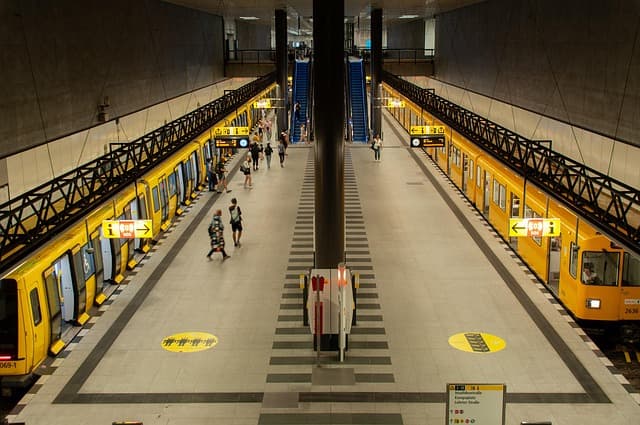
When it comes to the subway (which in Austria, as we all know, is only available in Vienna), you can buy a ticket from one of the ticket machines. They are located at the entrance to every station. Then, before boarding the train, you need to validate your ticket. You can do this immediately after purchasing it — special terminals are usually located next to the machines and are impossible to miss. In any case, before you reach the platform and board the train, you will pass by them.
Pretending to be a tourist and saying, “Kind people, why? I’m not from here! I didn’t know!” won’t work. Ticket inspectors are ruthless with all passengers. So be careful and don’t forget to validate your tickets.